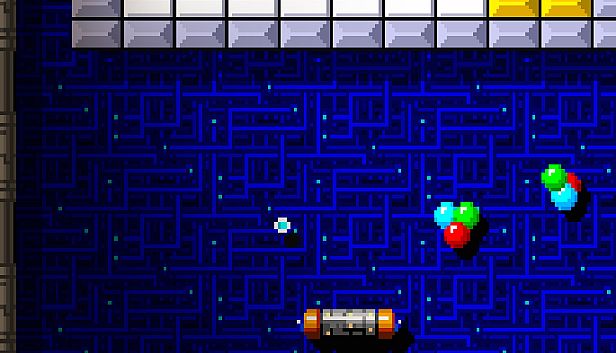



Arcade Archives 2 Arkanoid Revenge of Doh is a brick breaker action game originally released by Taito in 1987 as the sequel to the first Arkanoid. Players control a paddle at the bottom of the screen to bounce an energy ball upward and destroy formations of space walls across dozens of stages. The goal remains clearing each stage by eliminating all destructible bricks while avoiding the loss of the ball, with the added challenge of facing the dimension-controlling force known as Doh at the end.
Gameplay
The core loop centers on precise paddle movement and ball trajectory control. The energy ball ricochets off walls, bricks, and the paddle, requiring constant adjustments to maintain momentum and target remaining bricks efficiently. New elements from the 1987 original expand this foundation with branching stage paths that split into L and R versions after certain clears, allowing players to select different routes through the level sequence based on positioning. Brick variety has grown to include moving walls and regenerating types that reappear after destruction, demanding adaptive strategies beyond simple destruction.
Items appear frequently and provide temporary advantages such as expanded paddle size, multi-ball effects, or specialized weapons. The disruption item in particular now splits the energy ball into a higher number of projectiles than in the predecessor, creating opportunities for rapid screen clears when timed well. These power-ups integrate directly into the flow, rewarding players who position the paddle to catch them while keeping the ball in play. The experience stays single-player focused with alternating turns supported for two participants, emphasizing individual skill in survival and progression through the warped labyrinth of stages.
Game Modes
Four distinct modes shape how players approach the content. Original Mode delivers the unaltered arcade experience with standard progression and scoring. Hi Score Mode limits players to a single credit while tracking maximum points for global comparison. Caravan Mode restricts play to a fixed time window, typically five minutes, and records the highest score achieved within that limit.
Time Attack Mode, introduced in the Arcade Archives 2 lineup, shifts emphasis entirely to completion speed. Players race to finish the full game as quickly as possible, with score ignored in favor of elapsed time. This mode encourages riskier routes and optimized item use to shave seconds off each stage. All modes support online rankings, letting participants measure their results against others worldwide through dedicated leaderboards.
Modern Features and Accessibility
The release includes a suite of tools designed to preserve the original feel while easing entry for new players. Adjustable difficulty settings, screen options, rewind functionality, rapid-fire support, and multiple save slots allow customization without altering core mechanics. Variable Refresh Rate support further refines performance on compatible hardware, reproducing timing and responsiveness closer to the 1987 arcade cabinet than previous ports achieved.
These additions sit alongside faithful emulation of the 1987 visuals and audio. The branching L and R paths, expanded item roster, and varied brick behaviors remain intact, giving the game its distinct identity as a powered-up sequel rather than a simple rehash of the first Arkanoid.
Is It Worth Playing?
This edition suits anyone drawn to classic arcade block breakers who values precise execution and repeatable challenges. The combination of the original 1987 systems with Time Attack Mode and quality-of-life options creates multiple ways to engage, from high-score chasing to speed-focused runs. Online leaderboards add ongoing motivation for competitive players, while rewind and adjustable settings lower barriers for those new to the genre's unforgiving nature.
The package delivers a complete, self-contained experience centered on the 1987 content without extraneous additions. Players who enjoy mastering tight mechanics and exploring efficient paths through branching stages will find substantial depth here. Those seeking modern narrative or multiplayer depth may prefer other titles, but for fans of pure arcade action preserved with care, the release stands as a strong option on PS5.