




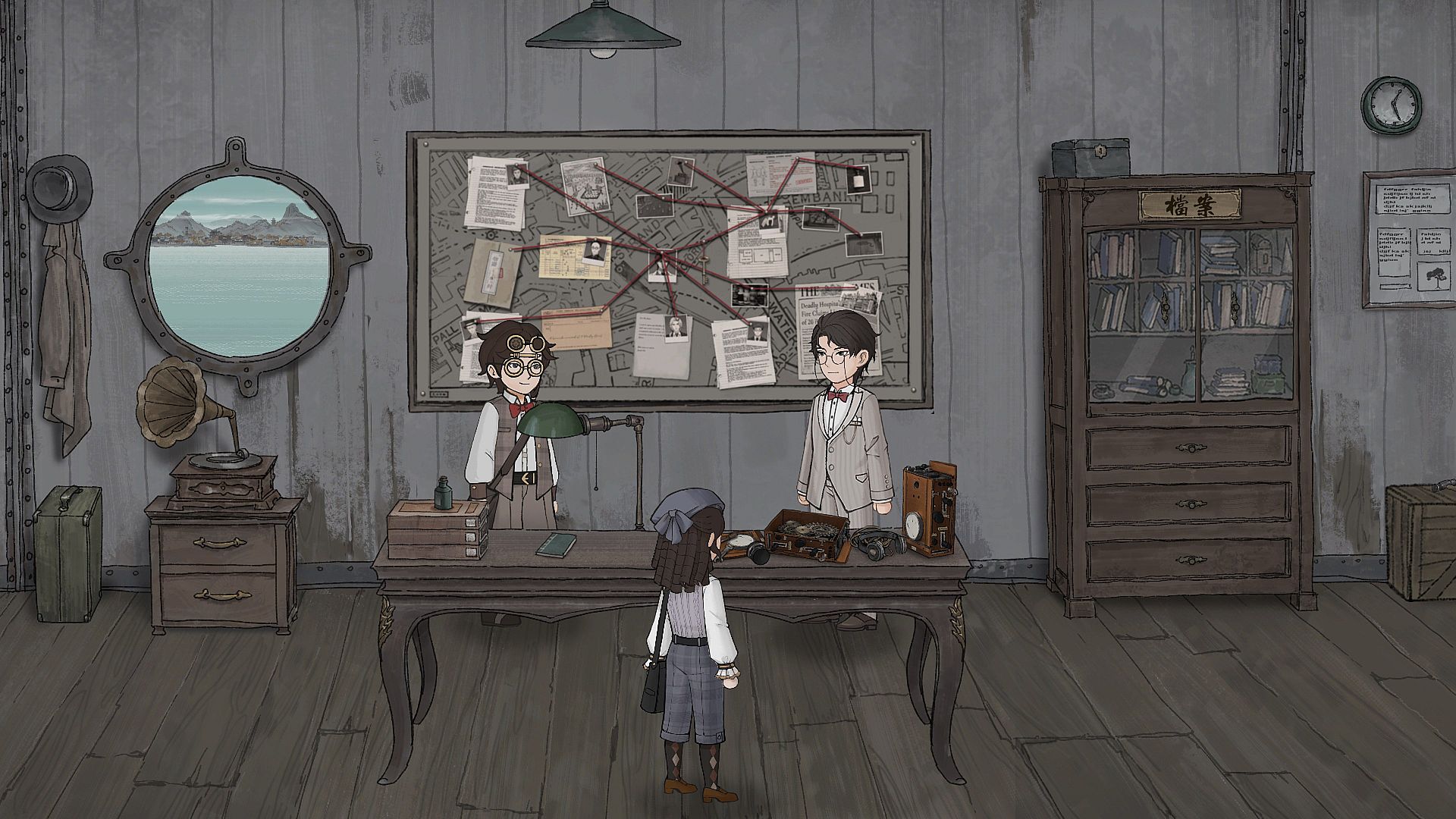









Murders on the Yangtze River is a side-scrolling detective adventure game that places players in the role of a protagonist navigating a web of interconnected mysteries set against the backdrop of late Qing Dynasty and early Republic of China. The experience centers on methodical investigation, evidence collection, and logical deduction to resolve a series of cases that gradually reveal deeper personal stakes and broader conspiracies.
Gameplay
Exploration occurs through straightforward side-scrolling movement across detailed 2D environments. Players guide the protagonist left or right to examine locations, interact with objects, and speak with characters using simple point-and-click controls. Hotspots appear clearly when nearby, allowing direct selection to gather information or trigger conversations.
Crime scene analysis involves searching areas for clues, with mechanics that require circling specific elements on screen to extract details and establish connections to the ongoing case. Witness testimonies are collected through dialogue, after which players identify inconsistencies or gaps that advance the investigation. Evidence presentation occurs in structured deduction sequences where gathered items must be applied to resolve contradictions and identify the responsible party.
Travel between major locations happens via a steamboat that serves as a narrative hub, marking chapter transitions while allowing continued exploration of new regions along the way. The core loop repeats across multiple cases: arrive at a site, gather physical and verbal evidence, cross-reference details, and reach a conclusion through deduction rather than action sequences.
Game Modes
The title operates as a single-player narrative experience structured around sequential chapters. Each chapter presents a self-contained mystery that players solve through the same combination of exploration, interrogation, and evidence analysis. These individual cases link together to form the overarching plot without branching paths or alternative play styles.
Progression follows a linear story framework where success in one investigation unlocks the next location and set of clues. There are no separate competitive or cooperative options, keeping the focus entirely on the protagonist's journey through the cases and the personal revelations that emerge from them.
Story and Historical Setting
The narrative unfolds across real historical landscapes of early twentieth-century China, including areas around Dongting Lake, the Yangtze River, Jiangnan waterways, and the foreign concessions of Shanghai. Environments recreate architecture, daily objects, and social conditions of the period through researched details drawn from archives and period references.
Cases involve ordinary individuals with complex backstories, where motives and methods reflect the cultural collisions of the era. The protagonist's own identity and past become entangled with the events, turning each solved mystery into a step toward larger revelations about revenge and hidden truths.
Is It Worth Playing?
Player feedback highlights the game's strengths in its authentic visual presentation and intricate case structures that reward careful attention to detail. Reviews consistently praise the fluid side-scrolling movement combined with point-and-click investigation for creating an engaging rhythm that differs from traditional visual novels while retaining strong mystery elements.
The experience suits those who enjoy methodical deduction and historical fiction over fast-paced action. With overwhelmingly positive reception across thousands of user reviews, the title delivers a complete story without ongoing seasonal content or additional modes. It stands as a solid choice for anyone seeking a focused detective adventure grounded in its specific time and place.