




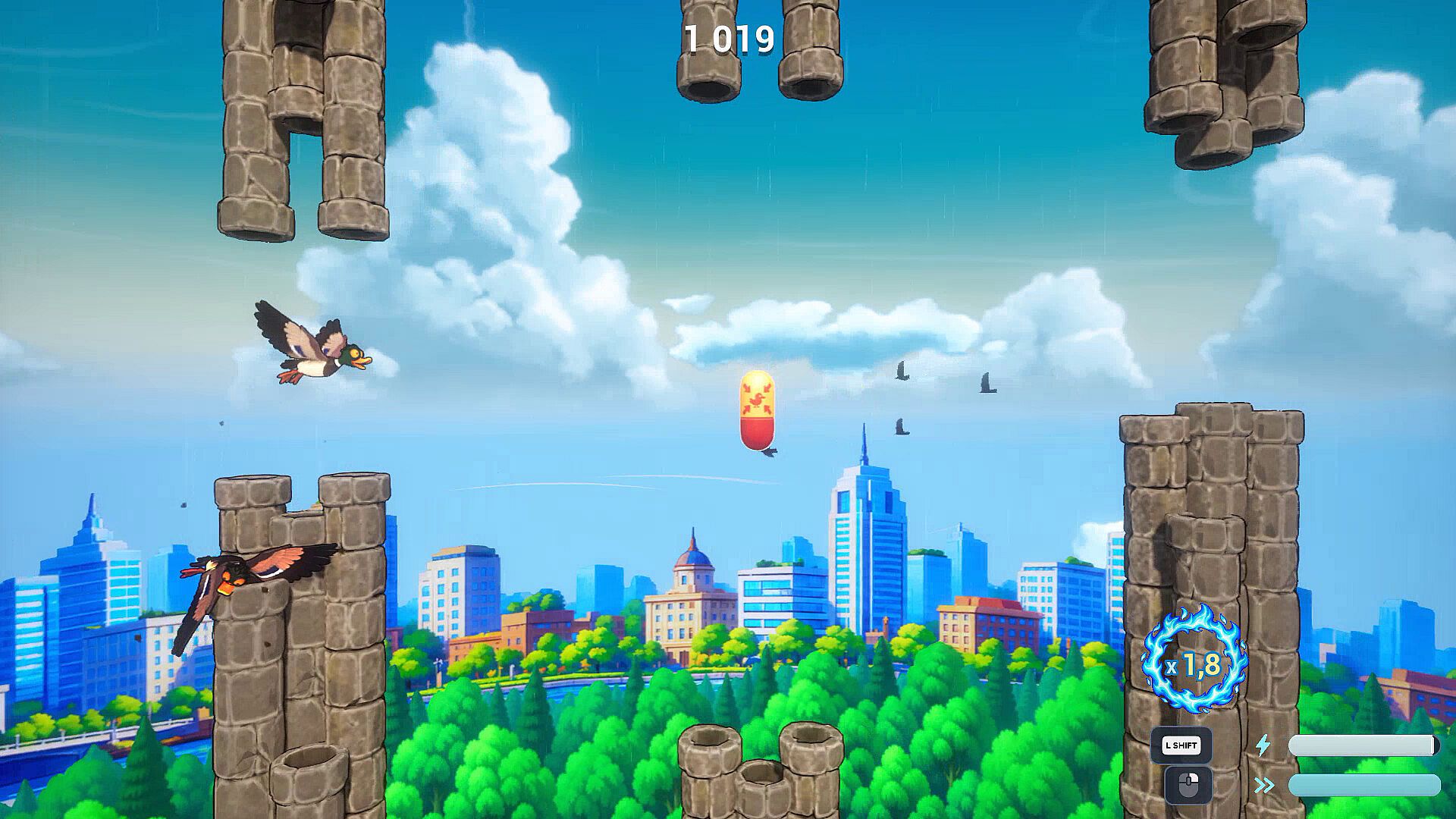

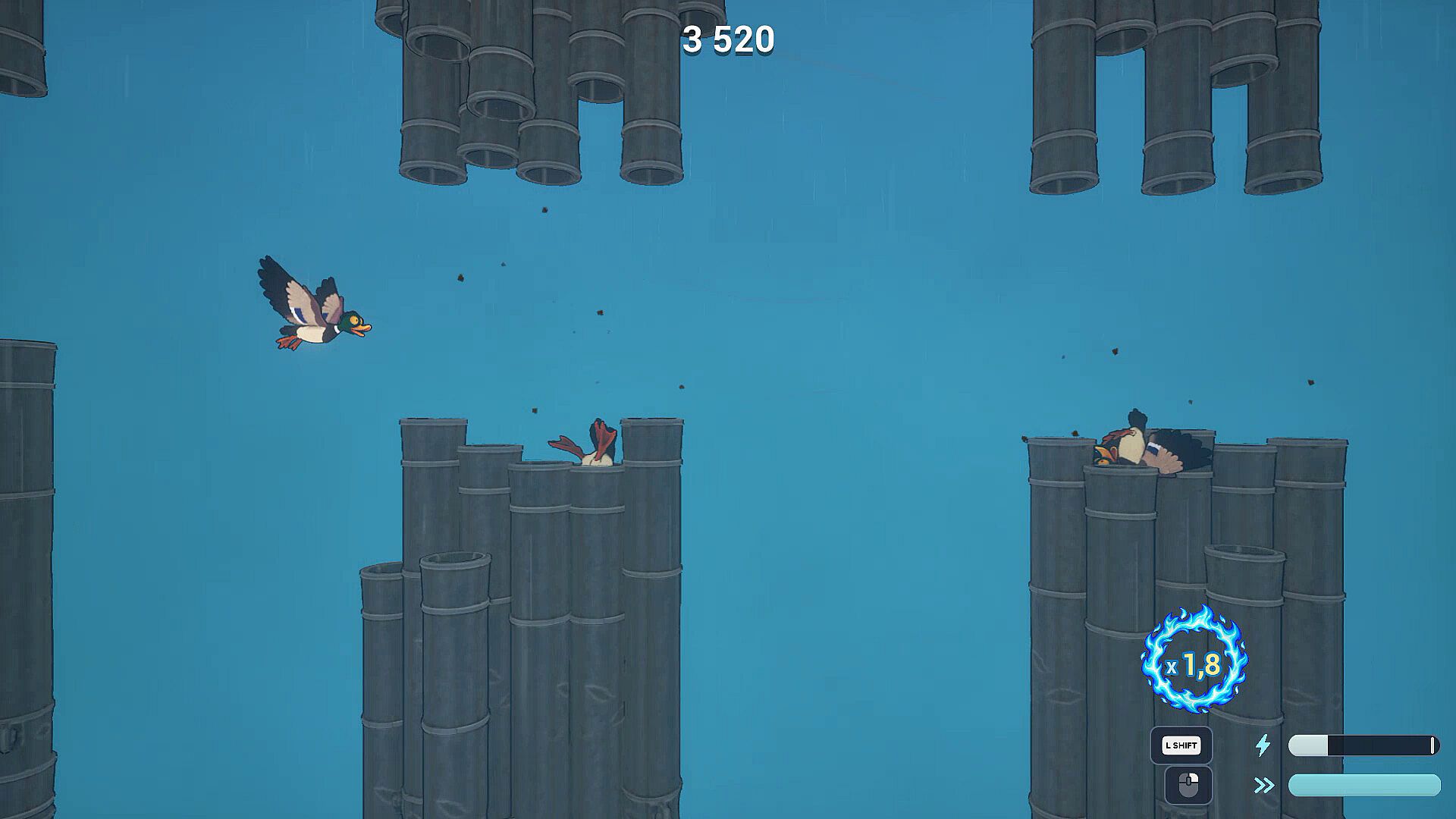




Unlucky Duck is a side-scrolling arcade game in the indie casual genre for PC. Players take control of a duck that must keep flapping to stay in the air while threading through gaps between pipes that grow tighter and more numerous the farther the flight continues. The core loop centers on survival and distance, with simple controls that encourage repeated attempts to improve personal bests.
Gameplay
The flight mechanics revolve around constant forward momentum and vertical adjustments through flapping. Gaps start wide but shrink steadily, while pipes increase in density and complexity. Holding sprint increases speed and builds a multiplier that enhances booster recharge or potency, raising the stakes as the run extends. This system rewards aggressive play but demands precise timing to avoid collisions.
Dashing allows straight-line movement at constant altitude, useful for clearing extended narrow sections once alignment is correct. Three boosters provide options to recover from mistakes or push further. The bomb destroys pipes ahead, with destroyed sections counting toward progress. Invulnerability lets the duck pass through pipes briefly. The pill shrinks the duck to fit smaller openings. These tools activate at key moments and scale with the speed multiplier for greater impact during longer flights.
Game Modes
Unlucky Duck focuses on a single continuous flight challenge without separate named modes. The experience emphasizes personal score chasing through repeated runs, where distance and survival determine success. Progression comes from mastering the balance between speed, booster use, and gap navigation rather than from distinct game variants or competitive structures.
Core Mechanics and Progression
Speed management forms the central tension. Faster flight widens the multiplier but compresses reaction windows, forcing players to decide when to push limits or conserve boosters. The duck starts with limited resources that recharge based on performance, creating a risk-reward loop that intensifies with each successful segment. Pipe layouts vary in pattern, requiring adaptation to vertical and horizontal spacing changes.
Booster timing integrates directly with the speed system. Using them at higher multipliers amplifies their utility, such as clearing more pipes with a bomb or extending invulnerability duration. This encourages experimentation with different flight strategies across attempts, from cautious gap threading to high-speed dashes supported by timely power use.
Is It Worth Playing?
Unlucky Duck suits players who enjoy short, repeatable arcade sessions with a strong emphasis on personal improvement. The straightforward controls and escalating difficulty create an immediate hook for those drawn to endless flight challenges. Its indie casual approach keeps sessions accessible while the booster variety adds layers for repeated play. The game appeals most to fans of precise timing and score-driven gameplay on PC, where quick sessions can fill brief periods without requiring long commitments. Those seeking deeper narrative or multiplayer elements may find the focused single-run structure limiting, but the core flight and recovery systems deliver consistent engagement for the target audience.