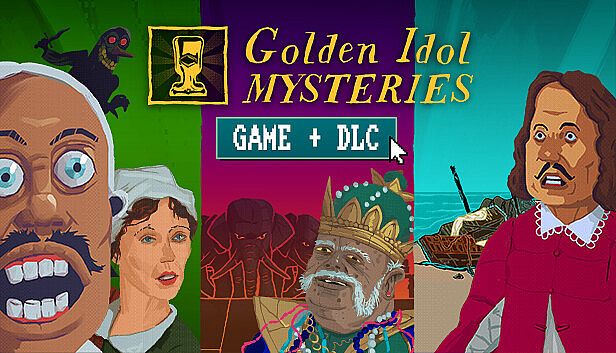













Golden Idol Mysteries delivers an indie adventure experience centered on deduction and investigation. Players step into a series of murder mystery scenarios set across the 18th century, examining crime scenes and piecing together events through careful observation and logical assembly.
Gameplay
The core loop revolves around examining detailed, animated dioramas that freeze moments around each death. Players click on characters, objects, documents, and spoken words to gather relevant terms such as names, actions, locations, and items. These terms populate an inventory at the bottom of the screen for later use. Navigation allows movement between rooms and inspection of personal belongings or containers without time pressure, encouraging thorough exploration of every detail in the frozen scene.
Once clues are collected, the process shifts to constructing the narrative. Blank slots in event descriptions require filling with the gathered terms to identify who was present, what occurred, motives involved, and the sequence of actions. This system demands precise matching and often includes variations across cases, such as determining full character identities or specific roles within groups. The approach rewards methodical cross-referencing and repeated review of the scene elements.
Game Modes
Two distinct modes structure each case. Exploring mode presents the static environment for free interaction, where players select and collect keywords from the visible elements and conversations. Thinking mode overlays the deduction interface, presenting incomplete statements that must be completed using the collected terms to resolve the full picture of events.
These modes operate sequentially within each scenario but allow switching back to the scene for additional clues if needed. The design keeps all gathered words accessible throughout, supporting iterative refinement of theories until the account of the incident holds together without contradictions.
The Cases
Each scenario focuses on a distinct death linked by an overarching thread involving a mysterious artifact. Cases span different locations and social circles, revealing connections through the accumulated details. The complete package incorporates the original twelve scenarios along with six additional ones that expand the timeline and backstory.
Progression involves solving one case before advancing, with each building on prior knowledge of recurring characters and elements. The structure emphasizes logical consistency over speed, allowing players to revisit earlier deductions as new information emerges from later scenarios.
Is It Worth Playing?
This title suits players who enjoy point-and-click adventures combined with puzzle deduction. The mechanics encourage active theorizing rather than following linear paths, and the cases maintain consistent quality in their design and interconnections. Positive player feedback highlights the satisfaction derived from correctly assembling complex events and the thoughtful integration of clues across the full set of scenarios.
Availability on PC supports straightforward access, and the single-player format focuses entirely on the investigative experience without additional layers. Those drawn to murder mystery puzzles that require building theories from evidence will find the approach engaging and self-contained.