




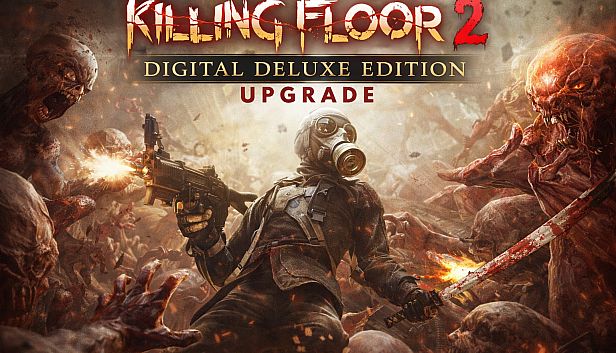














Killing Floor 2 is a co-op first-person shooter focused on wave-based survival against hordes of mutated enemies known as Zeds. The core loop centers on holding positions across maps while fending off escalating threats, managing limited resources, and coordinating with a small team to reach the end of each round.
Gameplay
Matches unfold across multiple waves that grow in size and introduce tougher enemy variants. Players select from a range of firearms and melee options, along with a healing syringe and a welder for sealing doors. Weight limits restrict how much gear each character can carry at once. Between waves the Trader appears briefly to sell or trade weapons, armor, and ammunition using earnings collected from kills.
Certain headshots or special eliminations trigger Zed Time, a brief slowdown that affects the entire battlefield and gives the team extra moments to reposition or finish off threats. The proprietary MEAT system governs enemy reactions, allowing dynamic dismemberment at multiple points on each Zed model. Limbs detach, torsos split, and gore interacts with the environment in real time. Melee combat uses directional inputs to produce different swings and strikes that can stagger or cripple specific limbs.
Four difficulty settings scale enemy health, speed, and numbers: Normal, Hard, Suicidal, and Hell on Earth. An optional dynamic system adjusts wave intensity on the fly based on team performance. Health regenerates only through syringes or teammate assistance, and downed players stay out of action until the current wave ends.
Game Modes
Survival forms the primary experience, pitting up to six players against successive waves that culminate in a randomly selected boss encounter. Enemy composition and count scale with player numbers. Endless Mode removes the wave cap and lets sessions continue indefinitely with steadily increasing pressure.
Survival VS introduces player-versus-player elements by allowing some participants to control Zeds while others remain as human mercenaries. Weekly Outbreaks apply temporary rule changes to standard Survival matches, altering enemy behavior or objectives for variety across limited-time events.
Progression and Perks
Experience earned from kills and objectives levels up individual perks that represent distinct playstyles. Each perk offers branching skill choices every few levels, letting players emphasize ranged accuracy, melee damage, support roles, or crowd control. These choices remain active for the duration of a match and influence available weapons and abilities.
Money collected during play funds immediate purchases at the Trader, while perk progression carries across sessions. Maps feature explorable areas that yield random drops of weapons, ammunition, and armor, encouraging movement between defensive positions.
Is It Worth Playing?
The game maintains an active player base years after release, with regular sales and limited-time events such as double experience periods still occurring into 2026. Reception highlights the satisfying weapon feedback, detailed enemy dismemberment, and tight co-op coordination required on higher difficulties. Servers remain populated enough for consistent matchmaking in the main modes.
It suits players who enjoy focused horde defense sessions rather than expansive single-player campaigns or frequent mode switches. Those who appreciate methodical resource management, team synergy, and visceral combat feedback will find repeated value in the core loop. Newcomers can start on lower difficulties to learn enemy patterns before moving to Suicidal or Hell on Earth settings.


