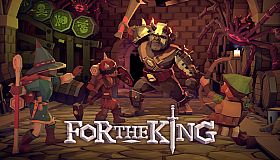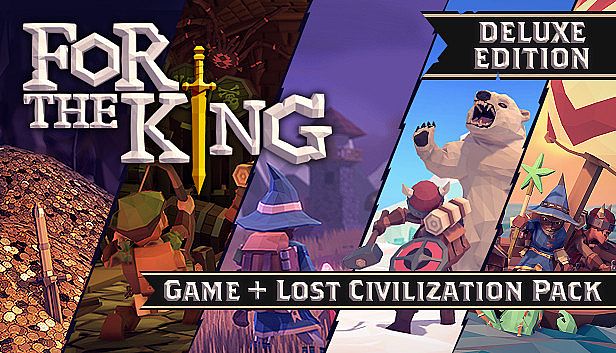












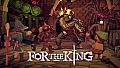
For The King is a strategy RPG that combines roguelike progression with turn-based combat and exploration across a procedurally generated world. Players assemble a party of three characters from a selection of classes and set out to restore order in the kingdom of Fahrul after the king's murder. The experience supports both solo play, where one person directs the entire party, and cooperative sessions with up to three participants who can split the group to cover more ground or stay together for safety.
Gameplay
The core loop centers on navigating a map filled with towns, dungeons, and random events. Movement occurs in turns, with decisions about which paths to take and how to allocate limited resources such as food and stamina. Encounters lead into combat that uses a slot-based system inspired by dice rolls, where players assign attacks and abilities to resolve fights against various enemies. Success depends on party composition, equipment gathered along the way, and careful management of health and conditions that can affect performance.
Exploration rewards players with new gear, weapons, and upgrades that carry over between runs only in limited ways due to the roguelike structure. Maps change with each playthrough while maintaining consistent landmarks and terrain types, encouraging repeated attempts to improve strategies. The system emphasizes planning and adaptation rather than direct control during movement or battles.
Game Modes
Several distinct campaigns alter the rules and objectives. The primary For The King mode focuses on a broad journey across the main map to confront the source of chaos. Dungeon Crawl narrows the scope to repeated underground expeditions with escalating challenges. Frost Adventure shifts the setting to colder regions with adjusted hazards and progression.
Additional options include Gold Rush, which introduces competitive elements among players, and endless dungeon variants for ongoing runs without a fixed endpoint. Each mode features its own story beats and rule variations while retaining the shared combat and exploration framework. Difficulty settings further customize the experience for different group sizes or skill levels.
Party Building and Progression
Ten classes provide variety in party composition, each bringing unique strengths in combat roles and utility skills. Players select and customize three characters before starting, balancing offense, defense, and support capabilities. Equipment and abilities found during runs enhance these roles, with choices about when to use limited healing or special attacks proving critical.
Progression feels tied to smart resource use and risk assessment rather than linear leveling. Random events and quests add layers of decision-making that can shift the party's fortunes mid-run. The design rewards experimentation across multiple attempts.
Is It Worth Playing?
For The King delivers a challenging tabletop-inspired strategy RPG suited to players who enjoy roguelike elements and cooperative decision-making. Reviews describe it as very positive overall, highlighting the blend of exploration, combat tension, and replayability through procedural maps and multiple campaigns. The game supports both solo control of the full party and local or online co-op, making it flexible for different preferences.
Those drawn to turn-based systems with dice-like resolution mechanics and party management will find consistent depth across its modes. The original release maintains active interest years later through its core systems, though it appeals most to fans of deliberate pacing and high-stakes runs rather than fast action. Availability on PC allows easy access for those matching this style.